

In partnership with

Welcome to Money As If, the free pizza you get after ordering ten $25 pizzas through your go-to pizza delivery app. Today's toppings:
DoorDash is the new avocado toast
What if houses … weren't an investment?
When even our memes go K-shaped
— Jeanine
P.S. Liking Money As If? Share that referral link below!
IN THESE, OUR (POSSIBLE) END TIMES
Is DoorDash the problem?
So the New York Times did this whole piece on food delivery and profiled (?) about a half-dozen or so Americans who spend an exorbitant amount of money on DoorDash, and a bunch of talking heads immediately took to social media to act like this meant something other than the fact that some Americans spend an exorbitant amount of money on DoorDash.
I'm not going to dwell too much on whether DoorDash or our collective refusal to thrift is "part of the affordability crisis," if only because we've been talking about this a bunch lately and so I'm sure you know where I stand.
I did want to point out (quickly) that any refusal to thrift, DoorDash-related or otherwise, could be just as much caused by the affordability crisis as it could be causing it.
If poor Ms. Reedy getting dragged in the tweet above saved all the money she’s currently spending on DoorDash each year ($15,600 in a worst-case scenario that assumes her highest estimate and doesn't deduct the amount she’d spend on non-delivered food), she still wouldn't have anywhere near the down payment or income needed to buy and afford a house in San Diego (median price: $972,713).
So perhaps that's at least "part" of why she's more inclined to just go ahead and order take-out pasta whenever she wants. I mean, the term "financial nihilism" wasn't coined on a whim.

Kudos to the NYT for giving me a reason to use this iconic Vanderpump Rules gif.
The other thing I'd like to just (again, quickly) say is that I'm not a fan of dragging everyday Americans for their spending habits, because, well, it's their spending habits. Money (and food) is emotional and if a family wants to spend $700 on takeout because they're burnout and too tired to make dinner, well, that's their choice and their financial issue to deal with. (We all have our things.)
Now, having said that:
We need to talk about DoorDash
Or food delivery apps in general, because, while they are not the problem, they certainly can be a problem if you're spending way more than you can or would like. And it's very, very easy to spend way more than you can or like to on food delivery apps, because:
They’re frictionless. No calling, talking, interacting, or even seeing people required.
They’re fee-laden. You pay anywhere from for $1 to $8 for the delivery itself, depending on time of day, distance, order size, and state regulation, unless you're a subscription member (DashPass, for instance, costs $96 a year or $9.99 a month). And there are other charges anyone can incur, like an express fee, a regulatory response fee, and a service fee that doesn't actually go to the person providing your service.
You've got to tip, which goes without saying but these apps don’t have the best reputation for paying particularly well. Base rates for a DoorDasher range from $2 to $10 per hour, though there are bonus earnings on the table, and Glassdoor puts current hourly wages at $8 to $25. Couple this with some guilt over asking someone to deliver you two donuts and a Dunkaccino in the early morning rainstorm, and it becomes also quite easy to tip well above-average.
Prices have gone up, since these apps exploded in popularity. That means, yes, app delivery fees cost more, but so does the food, as restaurants are now known to markup menu prices to cover the commissions they pay to appear on the platform. And then, of course, there's already today's frog-boiling-in-water inflation.
All this to say, you could be spending more than the more you've already realized you're spending.
How to spend less on food delivery
I bring these things up as someone who had to break a bad DoorDash habit established during the pandemic, when, in my defense (in everybody's defense!) the cost-to-value ratio was different. (You couldn't go anywhere! All we had was cheesecake!)
A good first step to breaking a bad money habit is recognizing how much — and why — it's actually costing you, so, yes, go ahead and add all those takeout orders up and, if you deem necessary, make an adjustment.
In the meantime, here are a few other ways to spend less on food delivery:
Consider getting a subscription membership to your go-to app if you order more than two to three times per month. At that rate, you’re likely to come out ahead against every-time delivery fees.
See if your credit card has any relevant perks or look into getting one that does. Chase has an ongoing partnership with DoorDash, while American Express offers a bunch of different benefits for Uber Eats. And some cash back cards will give you a kickback on select food purchases.
Time deliveries during off-peak hours and, if you don't have a set membership, compare prices across apps as they don't always charge the same prices.
Google promo codes, as they're not particularly hard to come by.
See if the restaurant lets you order directly. Same end result, not always the same price, given the restaurant doesn't have to pay itself commissions.
Money Management Making You Mad?

Most business owners hit revenue goals and still feel cash-strapped.
Not because they're not making money. But because their money flow is broken, their decisions feel urgent instead of strategic, and their systems feel fragile instead of solid.
The Find Your Flow Assessment pinpoints exactly where friction shows up between your business and personal finances.
5 minutes with the Assessment gets you clarity on:
where cash leaks
what slows progress,
whether your current setup actually serves you
No spreadsheets, or pitch. Just actionable insight into what's not working and why.
Educational only. Not investment or tax advice.
FRESH GREEN
Nowadays, most financial takes are boilerplate. These aren't.
Oh, man, I am for sure going to need this service one day.
I hesitate to share this tweet because the whole world-vs.-Boomers framing is not my jam and, in this case, it's particularly inaccurate. (Federal housing policy and suburban development in the ‘30s and ‘40s "came up with the idea" that homes were an asset; Boomers were just the first generation to really benefit from it.) And yet the underlying takeaway — that homes are just a good, no different than your car, a famously depreciating asset — made me, a child of the early ‘80s who doesn't quite belong to any generation‚ recognize an assumption I had my whole life (that a house surely is an investment) was, in fact, just an assumption. Plus, the tweet perfectly encapsulates the big argument mucking up policy on housing affordability right now: You can't bring housing prices down without affecting homeowners’ property values, a significant source of wealth for anyone, not just Boomers, who have paid down their mortgage. Now, the "investment vs. good" debate gets immediately complicated by the fact that houses sit on land, an absolutely finite resource. But, you know, for now, some food for thought.
Want to only spend $4 million instead of $8 million on a Super Bowl ad? Book a streaming-only spot. (ICYMI: The Seattle Seahawks and the Patriots meet in the big game at 6:30 p.m. ET this Sunday.)
NOT-A-THIRST TRAP
mmmmK
And, finally, today, in what are we even doing here anymore?
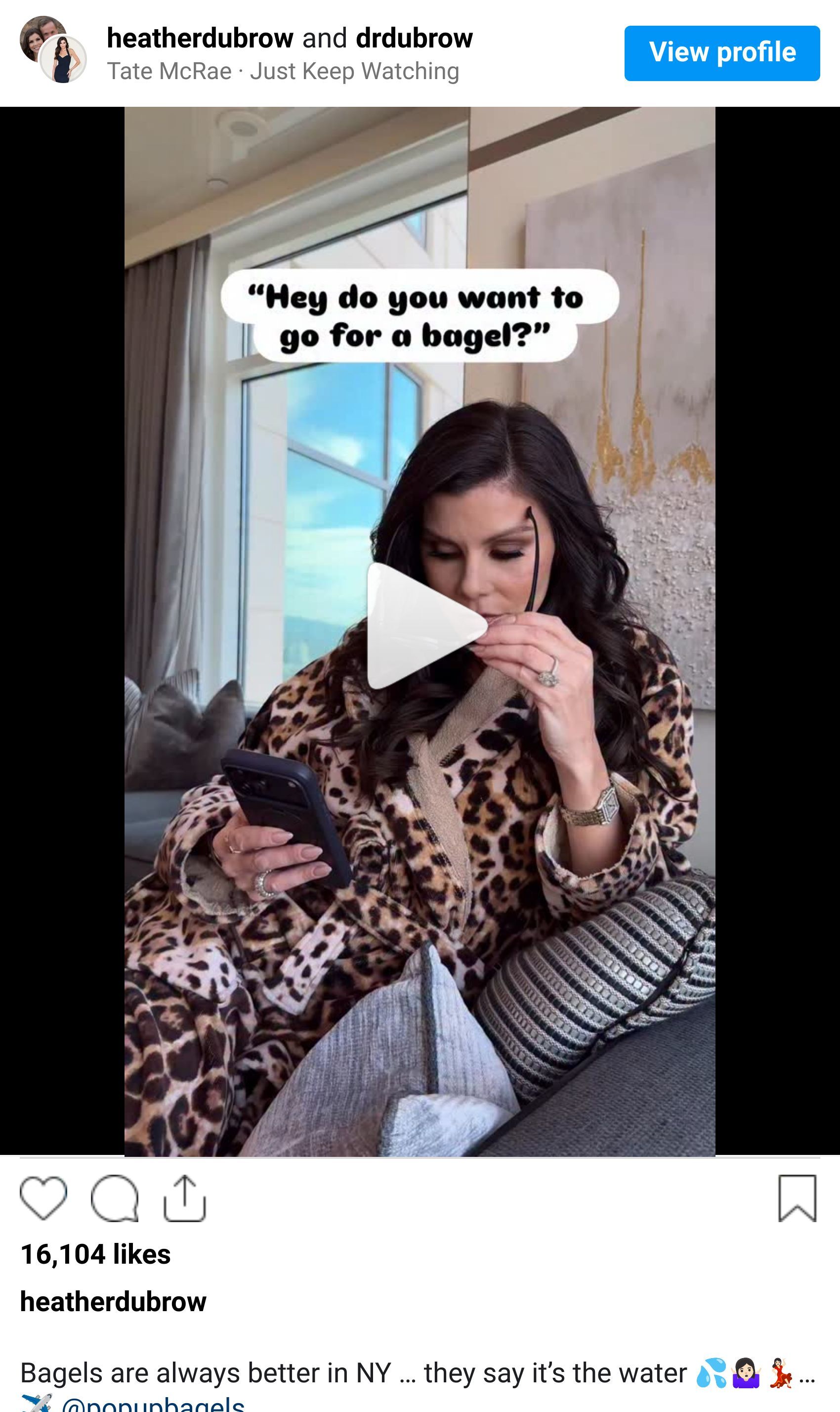
One of the small, annoying things about our K-shaped economy (as opposed to, you know, the big one) is how the upper part of the K feels absolutely no compunction.
During full-blown, non-discriminatory recessions, we tend to see an uptick in "stealth wealth" — i.e., the 1% adopts a lower-profile lifestyle as a protective measure, lest the other 99% band together and, I dunno, revolt or something.
And yet, in these, our fun-time, K-times, we get memes (like the one above) built totally around conspicuous consumption. TBF, Heather Dubrow isn't the only Real Housewife doing the "do you want a …?" trend. She just did it the best worst by also tagging every big luxury brand she and possibly husband Terry are wearing in the video.
I mean, I guess at least she didn't DoorDash that bagel. 🤷♀️
Got questions, comments, receipts, tips, thirst traps, etc. you’d like to share? Send them to [email protected].
This article is for educational purposes only. We don’t recommend or advise individuals to buy, not buy, sell, or not sell particular investments or other assets, as everyone’s circumstances are different. Also, it’s your money and ultimately up to you to decide the best use for it.