

In partnership with

Welcome to Money As If, the $325 authentic Xena: Warrior Princess real-steel chakram you won at an eBay auction. Today's bids:
A new way to evaluate your old splurges
Necessity is the mother of (haircut) invention
Jersey Gardens
— Jeanine
P.S. Liking Money As If? Share that referral link below!
IN THESE, OUR (POSSIBLE) END TIMES
What's the best stupid money you've ever spent?
So I was originally going to share this Instagram video in which RuPaul's Drag Race star (and past winner) Monet X Change shows off the expensive thing she bought that she would absolutely buy again as a Thirst Trap, because her $10,000 dress is amazing and her $500 custom Grumpkin is pretty cool, but then I realized she was walking us all through a valuable money exercise.
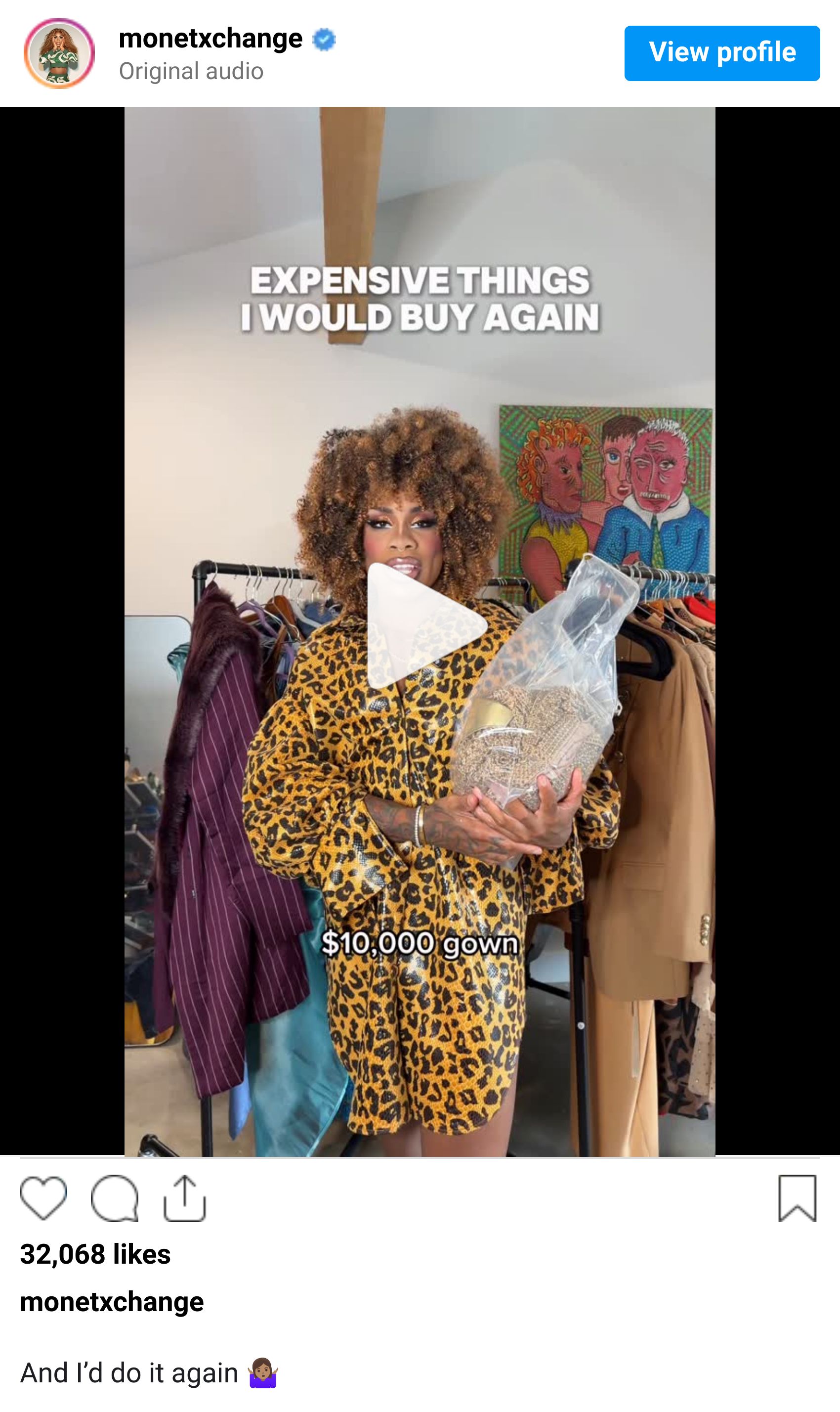
I talk quite frequently about splurging in Money As If because, IMHO, while money can't buy you happiness, per se, buying the right thing at the right time can certainly make you happier — and I don't like the idea that non-rich Americans are supposed to pretend otherwise.
I'm also aware that non-rich Americans live with finite resources in a world that is pretty much always trying to sell them something at increasingly high and sometimes frankly ridiculous prices (see this week's actual Thirst Trap), so choosing what to splurge on and when is difficult but unduly important.
These dueling realities (philosophies?) have led me, at least on occasion, to share some vague and admittedly unsatisfactory advice about naming your money values, reflecting on past purchases, and holding space for defying gravity (or something) when here was Monet X Change doing a solid for all us kinesthetic learners.
The best (and worst) stupid money I've ever spent
To that end, I listed out the best and worst stupid (re: outside my standard budget, inordinately expensive, or otherwise frivolous) money I've ever spent.
Here's what I came up with. (I'm not disclosing all the monetary amounts, because some are embarrassing and some I simply can't remember, but they all cost at least $500 or more, when adjusted for inflation.)
The best
$1,200 for a pair of tickets to see the recent Cabaret revival with my mother, gifted to her as a dual Mother's Day/birthday gift, though I'd be lying if I said I didn't independently want to go (Cabaret is my favorite Broadway show; I've actually seen its last three revivals.)
An upgrade to United Airlines Polaris first-class for an 11-hour flight home from a work trip, where I otherwise would have been crammed in the middle seat at the back of the biggest plane I've ever flown on. (Incidentally, I'm not the only person to buy this seat and not regret it.)
$6,000 worth of jewelry — a ruby ring for me and a platinum necklace for my husband — purchased on a post-IVF mental health escape to Aruba
The worst
IVF, though in fairness to IVF (I guess), I'm sure my feelings would be different if the outcome also had been.
A pair of purple, knee-high Coach "boots with the fur" that I didn't like enough to ever actually wear
One-fourth of the rent for a Jersey shore house during my first summer out of college, which might have been $2,000, and potentially a reasonable expense if it had been feasible to actually get a job down there.
Random list, for sure, but there are definitely themes throughout that can help inform my future impulses and demonstrate how such an exercise can help with yours. For one (and I swear I mean this as a general finding and not a pat on the back), I tend not to regret the things I buy for other people. Going to see Cabaret was worth it, but taking my mother to see It after a year of shuffling me back and forth to doctor appointments was (cliché, but true) priceless.
For another, I'm often OK with overspending on experiences or for convenience. I don’t think I'll ever upgrade to Polaris again, because it is, candidly, stupid expensive, but I am glad I got to live the literal high-life at least once, and to this day, I can't wrap my mind around getting through that flight otherwise.
On the flip side, I'm almost always dissatisfied when I spend solely on trendy things — or maybe things I think I'm supposed to want or buy without properly assessing whether I actually want them.
Boots with the fur and shore houses were all the rage back in 2004-ish, but never really my style, and I'm happy to report that I have gotten much better about not spending on expensive, now-viral things as I've gotten older and more hip to that fact. (You may recall that one time I successfully thwarted Labubus.)
Anyway, I'm curious to hear what you might learn about yourself, for better or worse, by going through the same experiment, so if you don't mind sharing, send me an email, and I'll perhaps round up some (anonymized) answers in a future issue!
What you don't know about the SpaceX IPO

Most retail investors will hear about the SpaceX IPO after it's too late, and the window to prepare is narrower than you think.
This exclusive briefing covers the early signals Wall Street is watching and the access paths most people don't know exist.
Inside this briefing, you'll discover:
The verified signals that typically appear before a major IPO filing.
What retail investors can legally access before a company goes public.
The positioning strategies serious investors evaluate before volatility begins.
FRESH GREEN
Nowadays, most financial takes are boilerplate. These aren't.
Service-y: Caity Weaver, who you may remember as the Gawker reporter who once spent 14 hours eating "endless" mozzarella sticks at a T.G.I. Friday's is out with a new magnum opus in which she identifies the best restaurant free bread in America. It's a long, long, (long) funny read only slightly spoiled by the fact that many people online guessed the winner (which, I suppose, also makes it accurate).
Behold, the overdue haircut, a new trend that
I startedinvolves wearing your hair "almost too long" or at "lazy-girl" length because what you really care about is span and body. As someone who only gets her hair done once a year solely because salons are so dang expensive, I can attest that you don't need to buy the $47 texturizing spray or the $149 curling iron to look like you skipped a few trims.More "how to pay for college in 2026" suggestions, this one from long-time personal finance reporter Beth Pinsker: Negotiate. Apparently, there are two main ways to do this: (1) appeal your financial aid offer and (2) actually ask the college to lower its tuition. The second one likely won't work at any of the Ivy Leagues, but you've got a shot if your kid has a lot of offers and a lot of A's.
THIRST TRAP
And, finally, today, in things I would buy if, you know, I could just buy things …
Weird New Jersey

Candidly, I can't decide whether to characterize The Pendry Natrirar, a 500-acre luxury resort in SOMERSET, NEW JERSEY, as a thirst trap or straight-up trap, because I really would like to go there. It has a spa, a farm with adorable lambs and chicks, hiking trails, and a fancy pants farm-to-table restaurant.
But a night in late-May — when the swanky outdoor pool is set to open — costs upward of $1,103 a night without any food or spa treatments, which is just absolutely wild, considering, again, this place is in Somerset, New Jersey (about 40 minutes, in fact, from my house).
Perhaps I shouldn't be too surprised. New Jersey is home to many weirdly expensive hotels. You may recall last summer, when my exploration of Long Branch unearthed Wave Resort, a seaside hotel that also costs over $1,000 a night during peak summer weekends.
But something about this Pendry place is tripping me up. Maybe because — fun fact!— the hotel gets its name from spelling Raritan backward, an allusion to the local river that sounds like an economy hotel (Radisson), and dispels any illusion that you've somehow wound up in the English countryside.
Still, if you can afford a visit, let me know how it goes.
Got questions, comments, receipts, tips, thirst traps, etc. you’d like to share? Send them to [email protected].
This article is for educational purposes only. We don’t recommend or advise individuals to buy, not buy, sell, or not sell particular investments or other assets, as everyone’s circumstances are different. Also, it’s your money and ultimately up to you to decide the best use for it.